

Written by Yusuf Novak, medical writer. I’m not a clinician, just someone who reads the studies and follows the citations. Last reviewed March 2026.
A friend sent me a screenshot from a wellness forum, someone raving about a nasal spray that supposedly cleared their “brain fog” and calmed their gut inflammation in about two weeks. The letters were VIP. I had never heard of it, which bothered me, because I usually have heard of these things. So I spent about a week doing what I always do when a supplement or peptide starts trending: I went to PubMed and started reading, ignoring every seller’s page until I understood the actual research underneath it.
Here is the honest version of what I found, written the way I wish someone had written it for me before I got three tabs deep into forum threads.
The question I actually had
Not “does VIP work,” because that’s the wrong first question. My real question was simpler: is there a real molecule under this marketing, and if so, how far does the evidence for it actually reach? Because those are two different things, and conflating them is exactly how people end up spending $200 a month on something that was tested for a completely different purpose than the one they’re buying it for.
So I started at the beginning, with the molecule itself.
What I dug up on the biology
Vasoactive intestinal peptide is a real, native hormone. Your body makes it. It’s a small chain of 28 amino acids, first isolated from gut tissue (hence the name), but it turns out to be active all over: brain, lungs, heart, the nerves connecting everything. It relaxes blood vessels, prompts glands to secrete, and, this is the part everyone in wellness circles is excited about, it dials down inflammation.
But here’s the thing I had to keep reminding myself while reading: the “VIP” for sale online isn’t your body’s own hormone released at the right moment in the right tissue. It’s a synthetic copy, usually a nasal spray, sometimes an injection, that you administer yourself on a schedule nobody has really nailed down. And there’s a structural reason nailing it down is hard. Native VIP breaks down in the bloodstream in something like a minute or two. It’s built to fire and vanish. That fact alone explains a lot of what follows, both the promise and the disappointment.
The strongest research I found was immunology, not wellness. A widely cited 2013 review in Amino Acids by Mario Delgado and Doina Ganea lays out VIP’s role as an anti-inflammatory signal in lab and animal models, turning down TNF-alpha, turning up IL-10, nudging the immune system toward regulatory T cells, across models of arthritis and colitis (PMID 22139413). That’s legitimate science, and it’s the actual foundation everything downstream is built on.
Then there’s a small stack of real human studies, tiny but genuine. In a 2003 Journal of Clinical Investigation study, eight people with primary pulmonary hypertension inhaled VIP and showed better pulmonary artery pressure and cardiac output, tolerated well (PMID 12727925). In a 2010 phase II trial in the American Journal of Respiratory and Critical Care Medicine, twenty people with active sarcoidosis inhaled nebulized VIP for four weeks. It was safe, and it lowered TNF-alpha production while raising regulatory T cells (PMID 20442436). I found those genuinely encouraging. I also noticed, twice, in bold in my own notes: eight patients, twenty patients, both under direct medical supervision, both nebulized, neither remotely resembling a self-administered nasal spray for fatigue.
A 2023 review in Life Sciences walked through the whole pulmonary picture, asthma, COPD, fibrosis, pulmonary hypertension, and its conclusion stuck with me: VIP keeps being a promising target whose development keeps stalling on the same wall, that the peptide degrades almost instantly, so getting a lasting useful dose into a person is genuinely difficult (PMID 37742737). Not a marketing problem. A physics problem, baked into the molecule itself.
What surprised me
I wasn’t expecting to find a large, rigorous, well-funded trial of synthetic VIP. But there is one, and it’s the single fact that reorganized how I think about everything else in this piece.
During COVID-19, a synthetic VIP called aviptadil got tested properly, the way real drugs get tested when there’s real money and real urgency behind them. The trial, TESICO, was randomized, placebo-controlled, enrolled more than 460 patients with COVID-related respiratory failure, and was published in The Lancet Respiratory Medicine in 2023. It didn’t work. The trial stopped early for futility. Ninety-day mortality came out essentially the same between groups, 38 percent on IV aviptadil versus 36 percent on placebo (PMID 37348524).
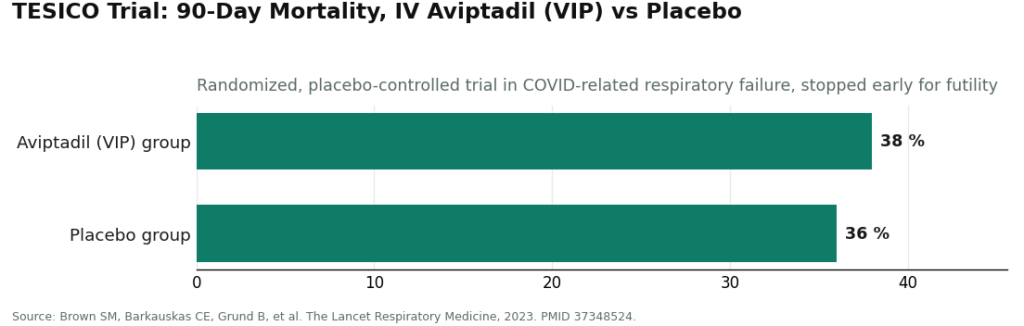
I sat with that number for a while, because it’s the kind of result a marketing page will never show you. This was VIP given every advantage a molecule can get: serious funding, a rigorous design, and a critically ill population where any real effect should have been easy to spot. It showed nothing. When I read a confident wellness website promising the same molecule will fix my energy or my focus through a nasal spray, I now measure that confidence against a trial that failed under ideal conditions. The website has far less evidence behind it than the trial that came up empty.
Following the wellness use back to its source
I wanted to know where the “VIP for brain fog and mold inflammation” idea actually came from, because it’s everywhere online and none of the pages selling it point to where it started. It traces back largely to one physician, Ritchie Shoemaker, who reported using intranasal VIP in patients he diagnosed with chronic inflammatory response syndrome (CIRS), tied to mold and water-damaged buildings, and published case series describing improvement.
I want to be fair to that work. It’s sincere, and it’s real in the sense that it exists and was published. But it’s also, and I looked for this specifically, largely uncontrolled and single-investigator. CIRS itself isn’t a settled diagnosis in mainstream medicine. I could not find a large, independent, placebo-controlled trial showing intranasal VIP reliably helps the general population of people now buying it for fatigue or focus or inflammation. If a seller’s page implies that question is closed, it isn’t being straight with you.
So where does that leave a buyer? Roughly here: a legitimate molecule, legitimate immune biology, a handful of small real human signals in specific lung conditions, and one big honest public failure. For the everyday wellness use it’s actually sold for, the evidence runs from thin to nonexistent. That doesn’t prove it does nothing. It means treat it as an experiment with genuinely low expectations, not a settled bet.
The dosing question I couldn’t get a straight answer to
I wanted a number. I didn’t get one, and once I understood why, I stopped being annoyed about it.
The human trials that exist all used inhaled or nebulized VIP, delivered in a clinic under medical supervision, at doses set for those specific lung studies. That’s a different route and a different setting than the intranasal spray or subcutaneous shot that ships to your door. So the doses floating around online mostly come from clinical practice patterns built around the CIRS use, which, again, rests on uncontrolled case data.
In practice, people report intranasal VIP in microgram-per-spray amounts, often starting low and titrating slowly, with the actual concentration set by whichever pharmacy compounded it. I’m not going to hand you a milligram figure to copy, because there isn’t a validated one, and a number lifted from a forum thread means nothing applied to a different vial with a different concentration.
Three things mattered more to me than chasing a precise number:
Delivery is everything, because the molecule doesn’t wait around. VIP degrades almost immediately, so how it’s formulated changes how much of it does anything at all. Treat dramatic claims from a casually made spray with real skepticism.
The compounder decides the dose, not you. A “0.5 mL nasal spray” is meaningless without the concentration behind it. That’s the actual argument for the supervised pharmacy path: someone qualified sets the real dose and the label reflects it.
Change one variable at a time and write it down. With something this uncertain, your own careful notes are close to the only signal you’ll get. Log dose, timing, and whether anything actually changed. Don’t stack it with three other new things or you’ll never know what did what.
What I’d actually do
If I were spending my own money on this, the molecule would stop being my main decision. The source would be. That’s the one variable I fully control, and it’s where nearly all the real risk lives.
I’d want a licensed clinician deciding whether I should use VIP at all, and at what dose. I’d want it dispensed through a real, licensed US compounding pharmacy, not shipped as a “research chemical” labeled not for human consumption, because that label is the legal loophole that lets a seller skip the clinician and the pharmacy entirely. I’d want to see independent testing, a certificate of analysis for what I actually received. And I’d want the seller to say plainly, in writing, that this isn’t FDA-approved and that the wellness data is limited. If a page buries that, it’s told me exactly how it sees me.
FormBlends is one outfit operating VIP through that kind of structure, physician-supervised, dispensed via a licensed US 503A compounding pharmacy, with the not-FDA-approved and compounded status stated up front rather than hidden. I’m naming it here as an example of the category worth shopping in, not as a product recommendation, there’s nothing to add to a cart on this page. The point is the structure: clinician, licensed pharmacy, visible testing, honest description of the evidence. Hold whoever you buy from to that same bar.
The price backs this up, too. Through a supervised, compounded path, VIP tends to run somewhere around $120 to $250 a month depending on form and dose. Research-chemical sellers will always undercut that number. Read the gap correctly: what the cheap version deletes is the clinician, the pharmacy accountability, and the person you’d call if something felt wrong. For a peptide acting on your nervous system and immune signaling, that’s not a bargain, that’s a bad trade.
Questions I kept circling back to
Is VIP FDA-approved? No. What’s sold for wellness is a compounded medication, not an approved drug, and it hasn’t been evaluated by the FDA for safety, effectiveness, or quality. Anyone implying otherwise is misleading you.
Will it actually fix my fatigue, brain fog, or inflammation? Nobody has shown that it reliably does, for the general population buying it for those reasons. The solid human data is small and confined to specific lung and inflammatory conditions, and the one large rigorous trial came back negative. It might help some individuals. It hasn’t been proven to, and I’d buy accordingly.
Why does the supervised version cost more than a research vial? Because you’re paying for what the cheap version strips out: a clinician deciding whether and how you use it, a licensed pharmacy making it under real regulation, independent verification, and someone accountable if something goes wrong. With a compound this uncertain, those protections are the actual product.
What’s the single thing worth getting right? The source. Whether a licensed clinician and a licensed pharmacy stand behind what you’re buying sorts the entire market into the part worth trusting and the part that isn’t.
Where I landed
VIP is a real hormone with genuinely interesting biology, a few small legitimate human signals, one very public and very honest failure, and a marketing layer that outruns all of it. My takeaway as a buyer isn’t that the science is boring, it’s the opposite. But interesting isn’t the same as proven, and I’d treat VIP as a carefully supervised experiment with modest expectations, not a sure thing. I’d put almost all my scrutiny on the source: a real clinician, a real pharmacy, real testing, and a seller willing to admit how thin the wellness data actually is. Get that right and you’ve controlled the part you can control. Skip it and you’ve taken the one genuinely uncertain compound in this story and stripped away every safeguard around it.
VIP sold for wellness is a compounded medication that has not been approved by the FDA. Consult a licensed healthcare provider before starting or changing any treatment.
Verified primary sources
All five sources were checked directly on PubMed; each PMID resolves to the paper described and supports the specific claim it is attached to.
- Delgado M, Ganea D. Vasoactive intestinal peptide: a neuropeptide with pleiotropic immune functions. Amino Acids. 2013. PMID 22139413. https://pubmed.ncbi.nlm.nih.gov/22139413/
- Petkov V, Mosgoeller W, Ziesche R, et al. Vasoactive intestinal peptide as a new drug for treatment of primary pulmonary hypertension. Journal of Clinical Investigation. 2003. PMID 12727925. https://pubmed.ncbi.nlm.nih.gov/12727925/
- Prasse A, Zissel G, Lützen N, et al. Inhaled vasoactive intestinal peptide exerts immunoregulatory effects in sarcoidosis. American Journal of Respiratory and Critical Care Medicine. 2010. PMID 20442436.
- Brown SM, Barkauskas CE, Grund B, et al. Intravenous aviptadil and remdesivir for treatment of COVID-19-associated hypoxaemic respiratory failure in the USA (TESICO): a randomised, placebo-controlled trial. The Lancet Respiratory Medicine. 2023. PMID 37348524.
- Zhong HL, Li PZ, Li D, et al. The role of vasoactive intestinal peptide in pulmonary diseases. Life Sciences. 2023. PMID 37742737.
For background on how compounded medications are regulated, the FDA’s human drug compounding overview is the primary reference:
What is VIP peptide and what does it actually do in the body?
VIP, or vasoactive intestinal peptide, is a 28-amino-acid neuropeptide your body already produces naturally in the gut, lungs, and nervous system. It relaxes smooth muscle, widens blood vessels, regulates immune signaling, and helps control secretion in the digestive tract. Researchers have studied it for roles in inflammation, circadian rhythm, and pulmonary function. The synthetic version mirrors that same sequence, which is why it attracts interest beyond basic physiology.
Is VIP peptide legal to buy in the United States?
It sits in a gray zone. VIP is not an FDA-approved drug for any indication, and it is not a controlled substance, so simple possession is not a crime. The FDA does restrict its sale as a finished drug product without approval, and the agency has sent warning letters to research-chemical vendors selling peptides for human use. The clearest legal path runs through a licensed compounding pharmacy working under a physician’s order, which puts the product under real regulatory accountability.
What side effects have been reported with VIP peptide?
The most consistently reported effects in clinical research settings are facial flushing, a drop in blood pressure, and a feeling of warmth shortly after administration. Nausea shows up occasionally. Because VIP dilates blood vessels, people who already run low blood pressure should be especially cautious. Long-term safety data in healthy adults is essentially absent, so anyone claiming it is well-tolerated over months is getting ahead of the available evidence.
Where can someone actually get VIP peptide through a legitimate channel?
The most accountable option is a physician-supervised compounding pharmacy. FormBlends, for example, operates in that regulated space, meaning a licensed prescriber is involved and the product is subject to compounding standards. Research-chemical websites also sell it, but those sources carry no prescription requirement, no guaranteed purity testing, and no clinical oversight. Anyone considering VIP for a health reason is better off starting with a doctor who can order labs and monitor them.


